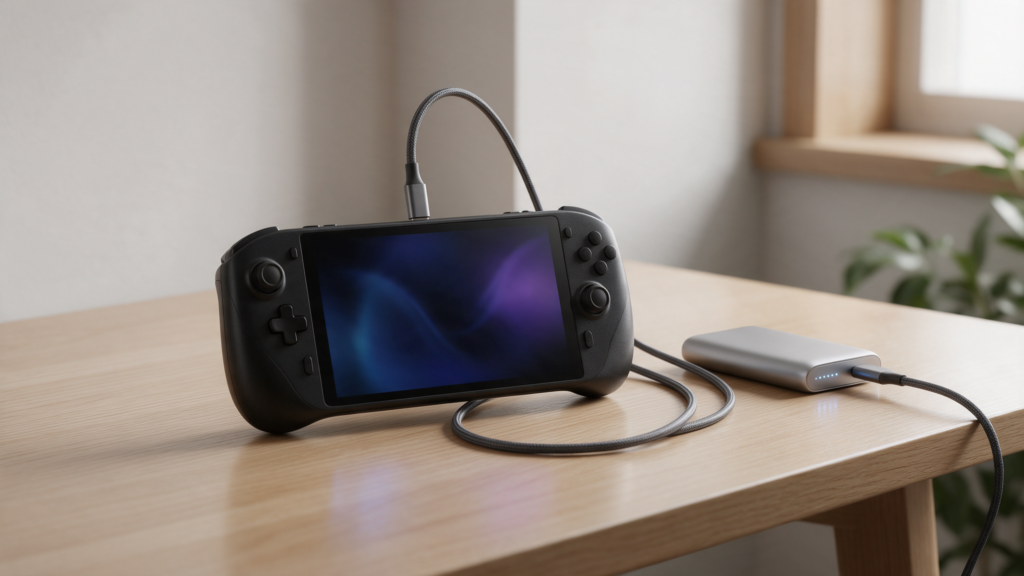
Last verified 2026-09-13 by ReviewGamers Editorial
Battery life is the specification people weight most heavily and understand least. Two handhelds with similar batteries can differ enormously in runtime, and it is not because one has a better battery.
Battery life is arithmetic
Capacity is quoted in watt-hours (Wh). Runtime is roughly capacity divided by draw:
A 50 Wh battery pulling 25 W lasts about 2 hours. The same battery pulling 10 W lasts about 5.
That is the whole model. Everything else is detail about what changes the draw.
This is why “how long does the battery last” has no single answer, and why any published battery figure without a stated wattage and workload is close to meaningless. It is also why we define our own performance targets with a power budget attached rather than just a resolution and a frame rate.
What TDP actually controls
TDP is the power budget you allow the chip. Raise it and you get more performance and less runtime. Lower it and the opposite.
The useful insight is that the relationship is not linear. Chips are typically most efficient well below their maximum. Pushing the last portion of performance often costs a disproportionate amount of power, which is why a handheld capped at a moderate wattage frequently delivers most of the experience for a fraction of the battery cost.
The practical habit: rather than asking “can it run this”, ask “what is the lowest wattage that holds my target frame rate”. That single change usually buys more real-world battery life than any accessory.
Screen, and the other draws
The chip is not the only consumer. Display brightness is a significant and controllable load. Wireless radios, controller charging and background processes all add up — and on a Windows handheld there are simply more background processes than on a console-shaped system.
Charging: what USB-PD actually does
USB Power Delivery is a negotiation protocol, not a wattage rating. The USB-IF describes device and charger exchanging what voltages and currents they support, after which the device requests the highest both ends can manage.
Consequences that matter when buying:
- A higher-wattage charger does not force more power into your device. It offers; the device decides. A 100 W charger will not damage a handheld that asks for 45 W.
- A charger can be the wrong shape, not just too small. If it does not offer the voltage the device wants, it may fall back to slow charging even with plenty of headroom on paper.
- The cable matters. High-wattage delivery requires a cable rated for it. A thin cable is a common cause of unexpectedly slow charging.
- PD 3.1 added 28 V, 36 V and 48 V levels extending the standard to 240 W, though most chargers in 2026 remain PD 3.0. For handhelds this is largely irrelevant — they sit well below those ceilings.
Charging while playing
Under sustained load a handheld can draw close to or beyond what a modest charger supplies, so it charges slowly or holds steady rather than gaining. This is normal rather than a fault. If you want to play while charging at high wattage, the charger needs headroom above the device’s peak draw, not merely above its idle draw.
Buying power gear in Australia
Mains chargers sold for use in Australia must be approved for local supply. An unapproved import is an electrical-safety question first and a warranty question second — if it damages the device, you are in a considerably worse position than if you had bought locally.
Consumer guarantees under the Australian Consumer Law apply to chargers and battery packs like anything else, and your claim is against the retailer. That is worth more than a small saving.
What we have not measured
We have not run battery tests. Our battery protocol measures runtime at fixed wattage targets on hardware we own, and until that exists we are not going to publish hours.
Manufacturer figures and third-party tests are useful for shape and ordering, not for planning a flight.