Last verified 2026-09-13 by ReviewGamers Editorial
The real differences are clearance, noise behaviour and how many things can fail, not raw capability.
Both do the same job by the same physics
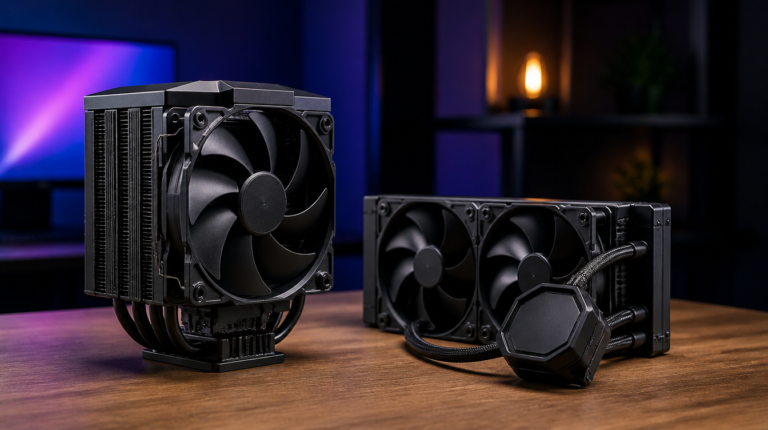
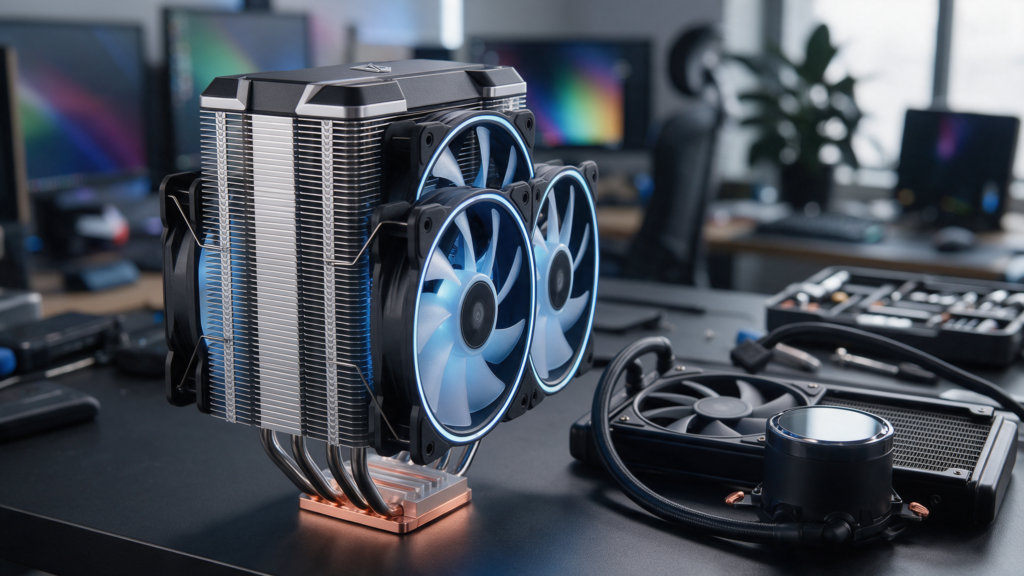
Both move heat from the processor to a finned surface, where fans transfer it into the air that then leaves your case.
A closed-loop liquid cooler relocates that finned surface to a radiator and uses a pump to carry heat there. It is not a different principle — it is the same principle with the heat exchanger moved somewhere more convenient.
The honest performance summary
A large, well-made air cooler is competitive with most mainstream closed-loop coolers. Liquid cooling pulls meaningfully ahead at the high end, with larger radiators and genuinely high-power processors.
If you are building a mid-range gaming machine, cooling capability is unlikely to be the thing that decides your build.
Clearance is the constraint that actually bites
Air coolers are tall, and a tall cooler may not fit under a side panel or may overhang memory slots. Radiators need a case mounting position of the right size, with clearance for thickness plus fans.
This is the specification to check first. Case makers publish maximum cooler height and supported radiator sizes; cooler makers publish dimensions. Checking those two numbers prevents the most common building mistake.
Noise is about fans, not about medium
Neither approach is inherently quieter. Noise comes from fan speed, fan quality and how hard the cooler is working relative to its capacity.
A liquid cooler adds a pump, which is an additional noise source, and pump noise is harder to ignore than fan noise because it is constant. An oversized air cooler running slowly is frequently the quietest option available.
Failure modes differ, and that is a real consideration
An air cooler has one moving part, and if that fan fails the heatsink still provides meaningful passive capability while you notice.
A closed-loop cooler has a pump. Pumps have a service life, and a pump failure removes cooling quickly. Liquid coolers are reliable, but they have a component that wears in a way a block of finned metal does not.
How to choose
Check case clearance first. Match cooler capability to your processor’s thermal figure with headroom for Australian summer ambient temperatures. Then choose on fit, noise and price.
Choose liquid if clearance favours a radiator, if you want the area above the processor clear, or if you are running genuinely high-power hardware. Choose air otherwise.
What would change this article
Thermal and acoustic measurement on our own bench across coolers in the same case with the same processor.
That is Tier A work with equipment we do not own. Everything above is mechanism, clearance specification and failure analysis.