Last verified 2026-09-13 by ReviewGamers Editorial
The gap between wired and modern wireless is now small. The gap between marketing numbers and felt difference is large.
What polling rate actually describes
Polling rate is how often the mouse reports its position to the computer. 1000Hz is a nominal reporting interval of one millisecond.
Moving from 125Hz to 1000Hz is a genuine, perceptible improvement and it is why 1000Hz became the standard. Moving from 1000Hz to 8000Hz reduces a nominal one-millisecond interval to a nominal eighth of a millisecond — a real change, and a much smaller one than the eight-times figure suggests.
The rest of the chain does not shrink with it
Your mouse is one link. The report still has to be processed, the frame still has to be rendered, and the display still has to show it.
Against a display refreshing every few milliseconds, shaving fractions of a millisecond off the reporting interval is a small proportion of total end-to-end latency. That is not an argument against high polling rates — it is an argument against expecting them to transform anything.
Very high polling rates are not free
Higher reporting frequency means more work for the host and more power drawn by the mouse. On wireless, battery life is affected directly.
Some systems also handle extremely high report rates less gracefully than others. It is worth knowing that the highest setting is not automatically the best setting on your particular machine.
Dedicated wireless and Bluetooth are not the same thing
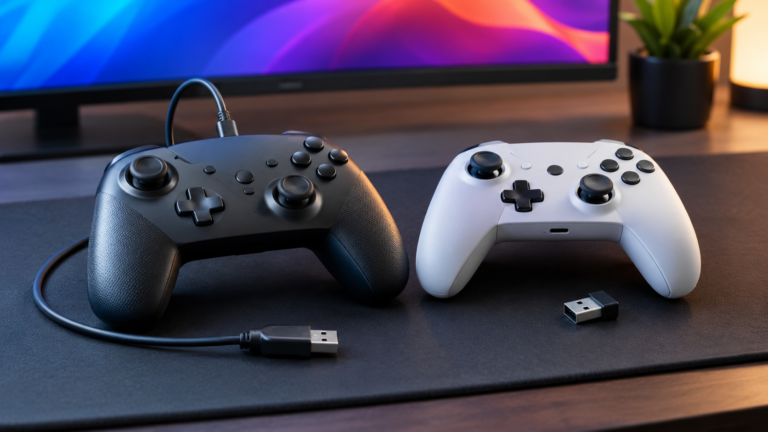
This is the distinction that matters most and is most often collapsed. A dedicated receiver using a proprietary protocol is engineered for low, consistent latency.
Bluetooth, per the core specification, is designed around power efficiency and broad compatibility. It is entirely fine for desktop work and is the wrong choice for competitive play. Many mice support both — check which mode you are actually in.
DPI is a sensitivity setting, not a quality rating
DPI or CPI describes counts per inch of movement. A very high maximum is a marketing number, because almost nobody plays at those sensitivities.
What matters is sensor consistency at the sensitivity you actually use: whether tracking stays accurate at speed and whether movement is reported linearly. Those are not on the box.
What to actually prioritise
Weight and shape first, because they determine whether you can aim comfortably for hours. Then a dedicated wireless receiver rather than Bluetooth for play. Then 1000Hz as a baseline.
Treat 8000Hz as a tiebreaker, not a requirement. A mouse that fits your hand at 1000Hz beats one that does not at 8000Hz, every time.
What would change this article
End-to-end latency measurement on our own bench — click-to-photon capture across mice, modes and polling rates.
That requires equipment we do not own. Everything above comes from the published specifications and from what the numbers mean.