Last verified 2026-09-13 by ReviewGamers Editorial
Switch choice looks like an overwhelming field of near-identical options with colour names. It is more tractable than that, because almost every switch is described by the same three properties.
The three properties
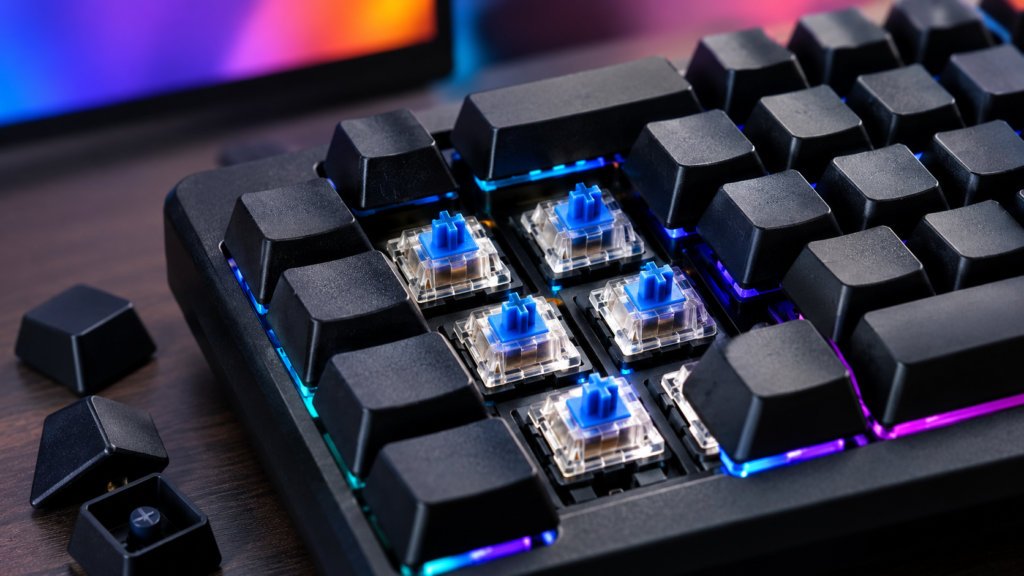
Type. Linear (smooth all the way down), tactile (a noticeable bump at the actuation point), or clicky (a bump plus an audible click).
Actuation force. How hard you press before it registers, in grams. Lighter is faster and more prone to accidental presses; heavier is more deliberate and more tiring.
Actuation point and total travel. How far down it registers, and how far it goes overall. Shorter actuation registers sooner.
Every switch you are considering is a combination of those three. Once you can name your preference in those terms, the field collapses from hundreds to a handful.
Which type for gaming?
Linear is the common recommendation for fast games, because there is no bump to push past on rapid repeated presses. It is also quieter.
Tactile gives feedback that a press registered, which many people prefer for typing and find no hindrance in games. If you do a lot of both, tactile is frequently the better all-rounder.
Clicky is the same bump plus noise. It is a preference, and it is a household and voice-chat consideration more than a performance one.
Be sceptical of claims that one type makes you measurably better. The genuine differences are comfort, noise and fatigue — which matter, but not in the way marketing implies.
Actuation force in practice
Lighter switches reduce effort over long sessions and allow faster repeated presses. They also make accidental presses more likely, particularly if you rest your fingers.
Heavier switches reduce mistakes and can feel more controlled, at the cost of fatigue.
Most people land somewhere in the middle and do not need to think about it further. If you experience hand fatigue, go lighter. If you make a lot of accidental inputs, go heavier. That is close to the whole decision.
Short-travel and adjustable switches
Some switches use contactless sensing rather than physical contact, which brings two advantages: no contact wear, and adjustable actuation — you set how far the key travels before registering.
That is genuinely useful if you want a very short actuation for games and a longer one for typing on the same board. It costs more and is less widely available, and the benefit is real but incremental rather than transformative.
The durability advantage is the same principle that applies to contactless controller sticks: a failure mode caused by physical contact does not begin when there is no contact.
The cheapest way to decide
Buy a switch tester. They are inexpensive, widely available in Australia, and let you feel a dozen options in a few minutes.
Reading about switch feel is close to useless — it is a tactile property described in adjectives. Five minutes with a tester will tell you more than an hour of research, and it will stop you buying a full keyboard you dislike.
If a tester is not practical, borrow. Most people who own a mechanical keyboard are happy to let you press it.
What actually matters more than the switch
Uncomfortable truths for switch enthusiasts:
- Board size and layout affect your desk and your mouse space more than switch feel affects your play.
- Stabilisers on the larger keys make a bigger difference to perceived quality than the switches do.
- Keycap material and profile change both sound and feel substantially.
- Whether it needs software running to keep your settings is a daily annoyance if the answer is yes.
A board with switches you like and poor stabilisers will disappoint you more than the reverse.
What we have not measured
We have not measured force curves, actuation consistency or latency on any switch. Manufacturer force-curve data is published and useful; it is not ours, and we are not presenting it as though we verified it.
Our keyboard guidance based on measured behaviour is held until we have boards in hand.