Last verified 2026-09-12 by ReviewGamers Editorial
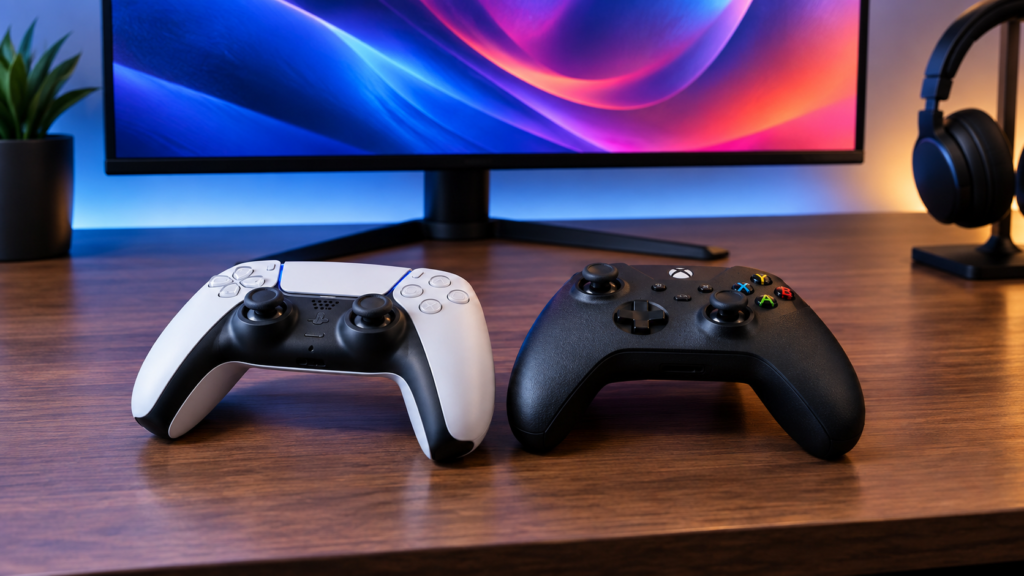
This one has a boring answer and an interesting one, and which applies depends entirely on whether you want a controller that disappears or a controller you notice.
The boring answer, which is right for most people
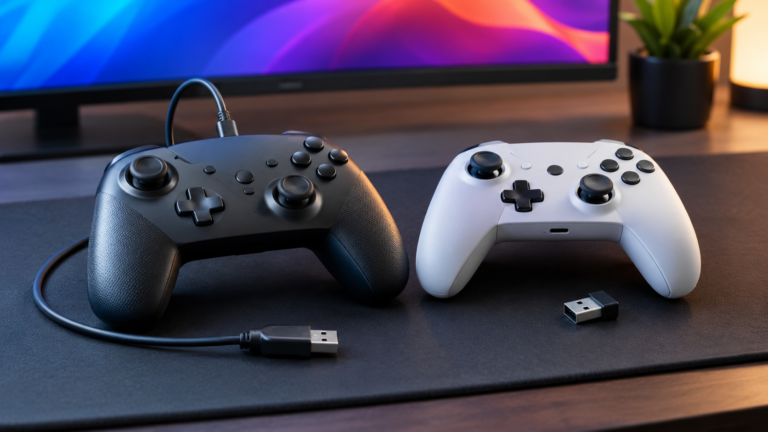
The Xbox controller is natively supported on Windows. It is XInput, which is the API effectively every PC game expects. Plug it in wired, or pair it with the official wireless adapter, and it works — correct button prompts, no configuration, no third-party software.
That is the entire pitch and it is a strong one. For most people asking this question, the correct answer is the Xbox pad, and the reason is friction rather than quality.
The interesting answer
The DualSense does something no other mainstream controller does: voice-coil haptics and adaptive triggers, designed as a feature rather than a rumble upgrade. Where it is supported, it is genuinely distinct — secondary coverage describes it as the best-feeling haptics in gaming.
The catch is the support conditions, and they are more restrictive than the marketing suggests.
Per secondary reporting, as of early 2026:
- Haptic feedback requires a USB connection on PC. It does not work over Bluetooth. If the appeal is wireless comfort, the feature you are paying for is off.
- Adaptive triggers have limited PC compatibility.
- Roughly 100+ PC titles support haptic feedback and around 60 support adaptive triggers.
That is not nothing, but it is a specific list rather than a general capability. Outside PlayStation-native ports, full feature parity may need an additional layer such as DS4Windows — which works, but is exactly the friction the Xbox pad does not have.
Latency: mostly a non-issue
Xbox controllers are generally reported to show lower latency on Windows, with Bluetooth differences narrowing by 2026. Between a wired Xbox pad and a wired DualSense, secondary sources describe the difference as not gameplay-affecting.
Our read: wired versus wireless is the decision that matters; brand-versus-brand at the same connection type is not. If you are chasing latency, plug in a cable. That single change outweighs the choice between these two.
We have not measured either. End-to-end latency measurement needs a defined protocol and a declared test rig, which is Tier B work by our evidence model.
Choosing by how you actually play
You want it to just work. Xbox. No configuration, correct prompts, universal support. Stop reading.
You mostly play PlayStation ports. DualSense, wired. This is the case where the haptics are most likely to be implemented properly, and where you will actually feel what you paid for.
You play wireless from a couch. Xbox. DualSense haptics are unavailable over Bluetooth, which removes the reason to choose it.
You have small hands, or comfort has been a problem. Ignore both spec sheets and go hold them. The DualSense and Xbox pad have meaningfully different grip geometry, and comfort over a three-hour session outranks every feature on this page. This is a genuinely personal variable.
You already own one that works. Keep it. Neither controller is a compelling upgrade over a functioning example of the other, and “which is better” is a much less useful question than “does mine still work”.
What neither of them fixes
Both use potentiometer sticks in their standard retail configurations, which means both are subject to the same wear-based drift mechanism over time. If stick longevity is your actual concern, the sensor type matters far more than the badge — see our explainer on hall effect vs potentiometer sticks.
That is a genuinely important point: people replace a drifting Xbox pad with another Xbox pad and are surprised when it happens again. The failure mode is structural, not brand-specific.
The Australian angle
Both are widely stocked through mainstream Australian retail, and that is worth something specific.
Under the Australian Consumer Law, consumer guarantees apply automatically and your claim is against the retailer. A controller that develops drift in an unreasonably short time for its price is a consumer guarantees matter, and pursuing that against an Australian retailer is materially easier than against an importer or an offshore seller.
Buying the marginally cheaper grey-import unit can cost you more the first time something fails.
The short version
- Want zero setup → Xbox.
- Mostly PlayStation ports, happy with a cable → DualSense.
- Playing wireless → Xbox, because DualSense haptics need USB.
- Comfort is your issue → go and hold both; neither spec sheet helps.
- Yours still works → keep it.
We have not measured latency, haptics or durability on either. When we do, it will appear here with the protocol published and the raw numbers attached. Until then this page tells you how the choice works and is explicit that it is not telling you how they measure.