Last verified 2026-09-13 by ReviewGamers Editorial
The framing is wrong, which is why the answers are confusing. “Wireless” covers two technologies with very different behaviour, and lumping them together produces advice that is half right.
The distinction that matters
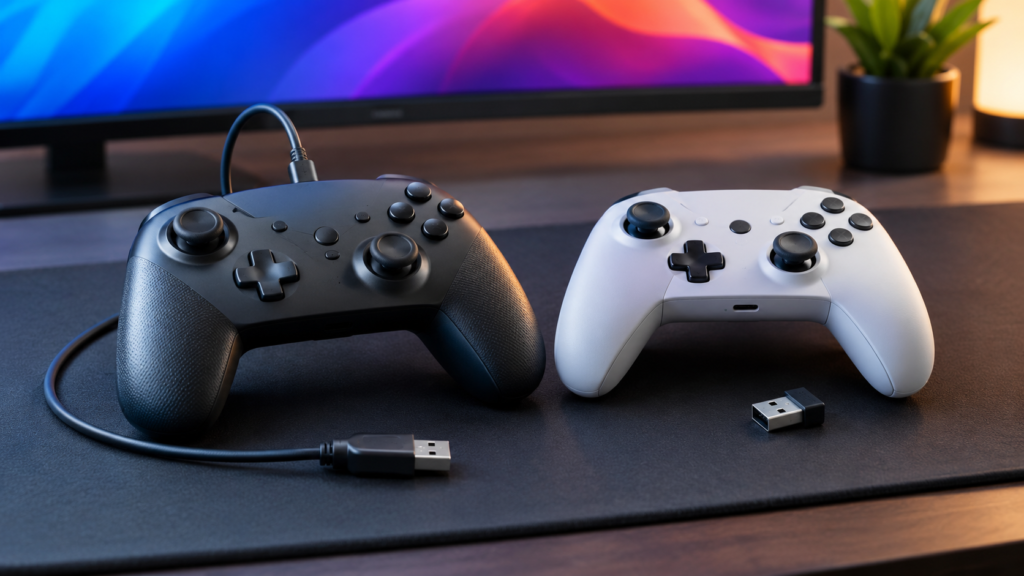
Bluetooth is a general-purpose radio standard designed for broad compatibility and low power. It typically updates at a substantially lower rate than a dedicated gaming receiver. It is convenient and it is the slowest option.
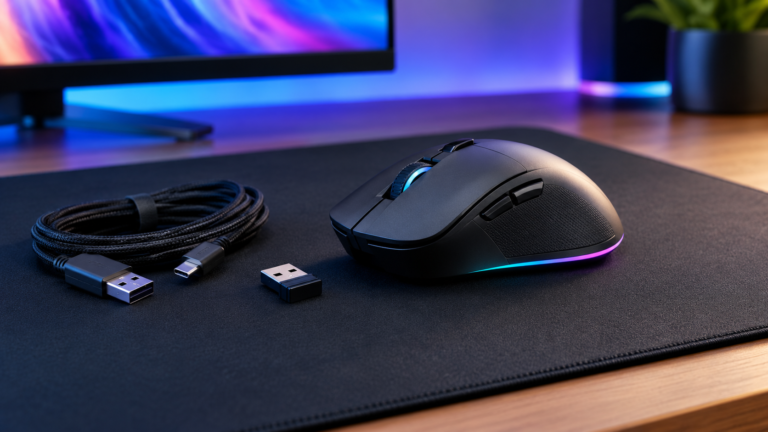
Dedicated 2.4GHz uses a proprietary receiver — a dongle — running a protocol built for input devices. Update rates are much higher and reported system latency for premium implementations sits close to wired equivalents.
Wired removes the radio entirely.
So the real ordering is: wired ≈ good 2.4GHz > Bluetooth, and the gap between the first two is small while the gap to Bluetooth is not.
Does it actually affect your play?
Honestly: for most people, in most games, no.
The difference between wired and a good 2.4GHz connection is small enough that reported comparisons describe it as not gameplay-affecting. If you play single-player games, co-op, racing, strategy or anything that is not twitch-competitive, this is not the thing limiting you.
Where it does matter:
- Fighting games, where inputs are judged in single frames
- Competitive shooters at high frame rates
- Rhythm games, where consistent timing is the entire mechanic
Even there, consistency matters more than absolute latency. A stable 12ms is easier to adapt to than something fluctuating between 6 and 20ms. Bluetooth’s weakness is often variability rather than the average.
The practical rules
- Playing competitively? Use a cable or a 2.4GHz dongle. Not Bluetooth.
- Playing from a couch, casually? Bluetooth is fine and the convenience is real.
- Noticing inconsistency rather than lag? Check for interference before buying anything — crowded 2.4GHz environments, USB 3 ports near the receiver, and distance all degrade wireless.
- Unsure? Plug in a cable for a session. It costs nothing and answers the question directly.
What people get wrong
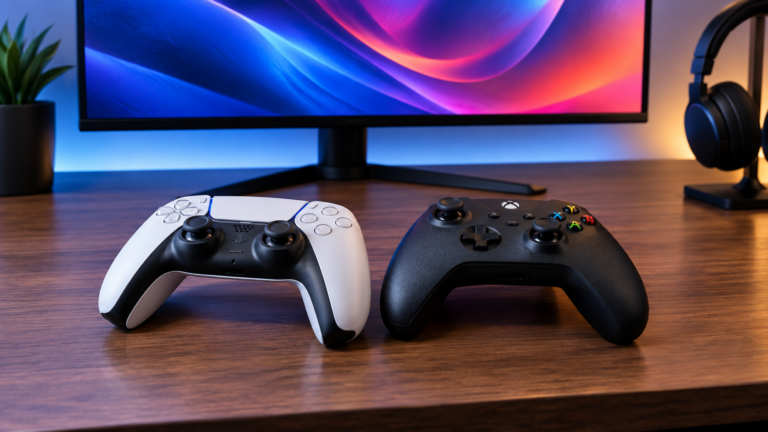
Assuming wireless is always worse. A modern 2.4GHz controller is not meaningfully handicapping you.
Assuming the controller is the bottleneck. Total latency includes the display, the frame rate, and the game engine. A high-refresh display or a stable frame rate usually contributes far more than the input device.
Buying a premium wireless controller then pairing it over Bluetooth. Common, and it discards the feature you paid for. If a controller ships with a dongle, use the dongle.
Battery, the trade nobody mentions
Wireless means charging. A controller that dies mid-session is a bigger practical problem than a few milliseconds, and rechargeable performance degrades over years.
If you play long sessions and dislike managing charge, wired removes a category of annoyance entirely — which for many people is worth more than the latency argument in either direction.
Buying in Australia
Both types are widely stocked locally. That matters because controllers are a high-failure-rate category — sticks in particular wear — and consumer guarantees under the Australian Consumer Law are pursued against the retailer. A local purchase makes that practical.
If stick longevity is your real concern, the connection type is the wrong variable. The sensor technology inside is the one that decides it.
What we have not measured
We have not measured controller latency. Doing it honestly requires the devices, a defined protocol and equipment capable of resolving single-digit milliseconds — that is our end-to-end latency protocol, and it is held until we have the hardware.
The figures above are attributed to named sources and describe the shape of the difference, not our measurement.