Last verified 2026-09-13 by ReviewGamers Editorial
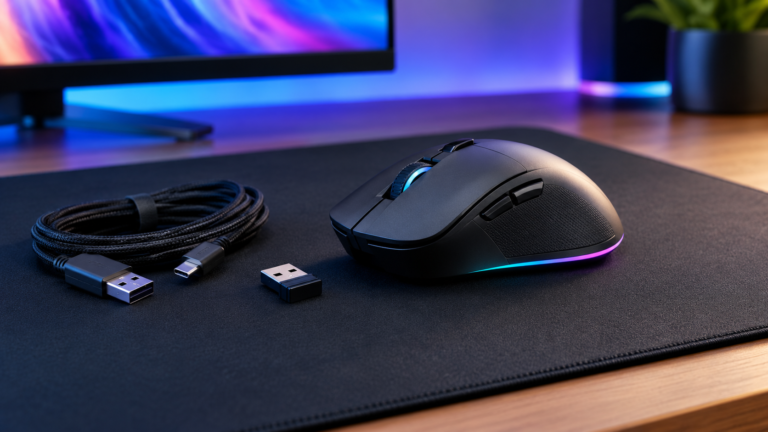
Mouse marketing is unusually disconnected from mouse performance. The specification printed largest is generally the one with the least bearing on how well you play.
DPI is not accuracy
A 32,000 DPI sensor is not more accurate than a 1,600 DPI sensor. DPI is how many steps the sensor reports per inch of movement — sensitivity, not precision.
Turning it up amplifies everything, including hand tremor and surface noise. This is why the widely reported practice among competitive players is 400 to 1,600 DPI, with in-game sensitivity tuned so a full arm sweep produces a 360-degree turn.
The right DPI is the one where you can track a target smoothly without running out of mousepad. It is a personal setting, not a quality rating, and any mouse from the last decade can reach it.
Polling rate: real, but situational
Polling rate is how often the mouse reports position. 1000Hz means once per millisecond.
Premium mice now advertise 4000Hz and 8000Hz, and there is a genuine effect — but it is bounded by your frame rate. Below roughly 200fps, the display and the frame rate are the limiting factors, not the mouse. At 300fps and above, higher polling produces measurably smoother tracking.
So: if you play at very high frame rates on a high-refresh display, this is a real if modest improvement. If you play at 60 to 144fps, it is a specification you are paying for and not using. Very high polling also increases CPU overhead and drains a wireless battery faster.
Wireless has genuinely caught up — with one exception
Premium 2.4GHz wireless implementations achieve system latency reported as statistically indistinguishable from wired equivalents. The old advice that wireless is handicapping you is out of date for good implementations.
The exception is Bluetooth, which polls far less frequently and introduces delay that is noticeable in fast games. If a mouse offers both, use the dongle for anything competitive and keep Bluetooth for travel.
One caveat worth knowing: below roughly the budget tier, wired still outperforms wireless at the same price, because cheap wireless spends its budget on the radio rather than the rest of the mouse.
What actually decides a good mouse now
Sensor quality has largely converged — nearly every current sensor tracks properly on normal surfaces. So the decision has moved to things that are harder to put on a box:
Shape and size, judged against your hand. The single largest factor in comfort and consistency, and the one most people ignore. Measure your hand and check the mouse’s actual dimensions rather than trusting a marketing shape name.
Grip style. Palm, claw and fingertip grips suit different lengths and heights. A mouse that is excellent for one can be poor for another.
Weight. Lighter helps with rapid aim; too light feels unstable to some people. There is no correct answer, only a personal one.
Switch feel and durability. Where cheap mice fail first, usually as double-clicking.
Cable or wireless reliability, and whether the software is required to keep settings.
The honest buying sequence
- Measure your hand — length and width.
- Identify your grip.
- Shortlist by dimensions and weight, not by DPI.
- Then consider polling rate, and only if you actually play above 200fps.
- Ignore the DPI number entirely.
Buying in Australia
Mice are light and cheap to ship, so overseas purchases are tempting. The saving is often smaller than it appears once shipping is included, and switch failure is common enough within a couple of years that consumer guarantees matter.
Under the Australian Consumer Law goods must be of acceptable quality and durable for a reasonable period given the price, and the claim is against the retailer. A premium mouse developing double-click within a year is a reasonable claim to make locally and an awkward one to make offshore.
What we have not measured
We have not measured sensor behaviour, click latency or shell dimensions ourselves. Our mouse guidance based on measured shell geometry and hand-size fit is held until we have units in hand.
Everything above is attributed or is a decision rule. None of it is our measurement.