
Last verified 2026-09-27 by ReviewGamers Editorial
DirectStorage gets talked about like a setting you flip on in Windows. Microsoft’s own documentation describes something narrower: an API a game’s developer has to actually build against, not a system-wide toggle.
It is a developer feature, not a Windows setting
DirectStorage is part of the DirectX family, and Microsoft’s own developer blog is clear that it exists to let a game batch thousands of storage read requests efficiently instead of handling them individually. That only helps a game that has been coded to actually call the API — installing Windows updates does not retroactively add DirectStorage support to a game that never implemented it.
What Microsoft’s own numbers claim
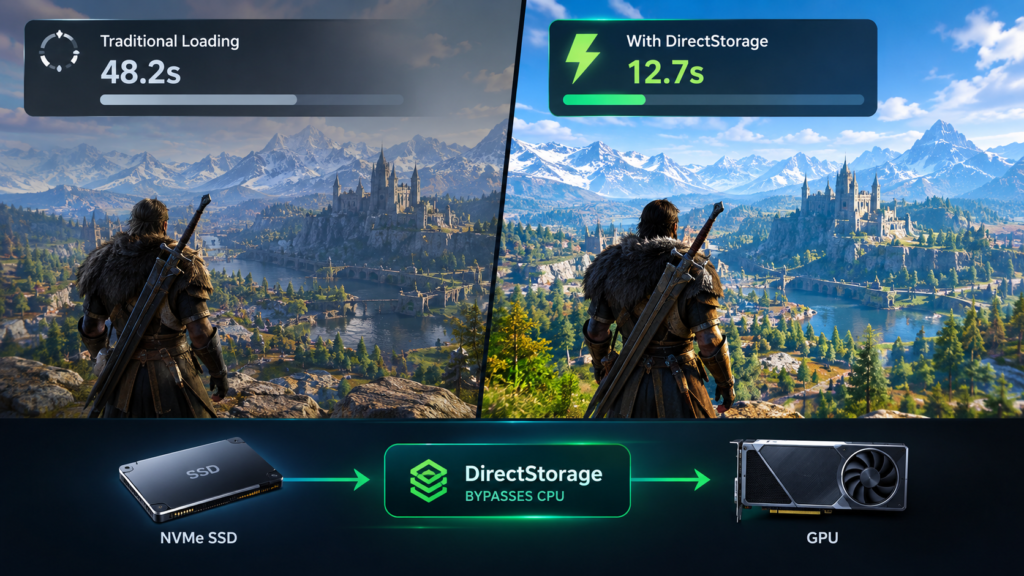
Microsoft’s developer blog states that games installed on NVMe drives and built with DirectStorage can see load time reductions of up to 40%. With GPU decompression, introduced in DirectStorage 1.1, Microsoft’s own figures describe load times close to three times faster than CPU-based decompression, since the CPU is freed from handling that work.
GPU decompression is a separate step, not automatic
DirectStorage 1.1 added GPU decompression as an option that moves decompression work off the CPU and onto the graphics card. This is a distinct feature from the base DirectStorage API, and a game can support basic DirectStorage without necessarily using GPU decompression specifically.
What it needs from your hardware
Microsoft’s own documentation ties the meaningful gains to NVMe storage rather than a mechanical hard drive or a SATA SSD. A slower storage interface removes the bottleneck DirectStorage is designed to relieve, so the API has less to work with even in a game that supports it.
The takeaway
DirectStorage’s improvements are real according to Microsoft’s own published figures, but they only apply to games specifically built to use it, running on NVMe storage. Check whether a specific game lists DirectStorage support before expecting any change in its load times.