Last verified 2026-09-12 by ReviewGamers Editorial
A discount percentage tells you what someone decided to call the original price. That is all. It is a marketing number, and treating it as information is how people end up paying more during a sale than they would have paid a month earlier.
Here is what actually tells you something.
1. Price history beats percentage, always
The only meaningful question is: what has this actually sold for over the last year?
A “40% off” on an inflated reference price can be worse than last month’s quiet, unadvertised price. Conversely, a modest-looking 15% can be a genuine historical low on something that rarely moves.
The good news is this data is free and always has been. CamelCamelCamel provides Amazon price history and drop alerts at no cost, funded by affiliate commissions, with no paid tier. IsThereAnyDeal, GG.deals, SteamDB and DekuDeals cover game pricing across storefronts. OzBargain surfaces Australian deals through its community.
Nobody should pay for a price alert. The alert layer is a solved, free problem. If a site wants a subscription for a notification, walk away.
2. Check the shape, not just the low
A single historical low is a weak signal by itself. What you want is the pattern.
- Does it drop often, in small amounts? Then today’s drop is not special, and waiting costs you little.
- Does it sit flat then drop hard, twice a year? Then a rare drop is worth taking, because the next one is months away.
- Is it trending down steadily? Often a sign a successor is coming. Now may be a fine time to buy cheap — or a terrible time to buy at all.
- Has it never dropped? Either it is new, or demand exceeds supply. Waiting may achieve nothing.
The same 20% discount means completely different things across those four patterns. This is the single biggest gap between “there is a sale” and “you should buy”.
3. Price the whole thing, not the headline item
The most common self-inflicted bad deal.
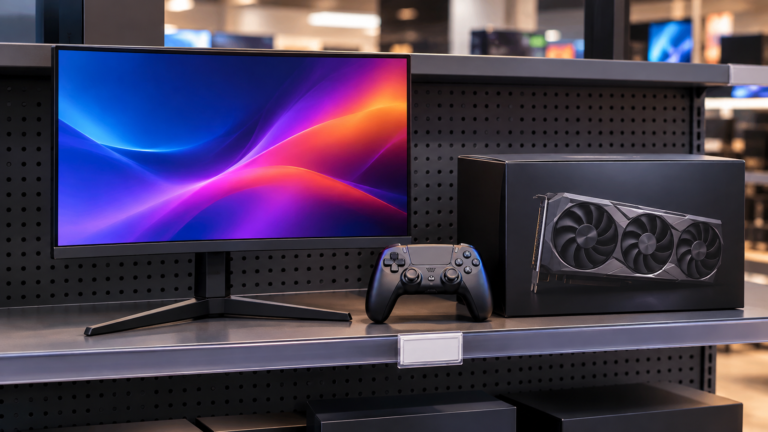
A handheld at a good price that needs a card, a case and a dock is not the price on the tag. A monitor that needs a different cable, an arm, or a GPU you do not have is not the price on the tag. A controller that needs a wireless adapter is not the price on the tag.
Write down the total you will actually spend before you compare anything. People routinely take a worse deal on a bundle because the headline number was lower.
4. Ask what you are giving up
Cheaper often means something.
- Grey-market key sellers are cheaper because the key’s provenance is unknown and the revocation risk sits with you — see which game key stores are legitimate.
- Grey imports are cheaper because you are giving up a practical path to enforce Australian consumer guarantees against a local retailer.
- Open box and refurbished can be genuinely good value, but check who carries the warranty and for how long.
- An older model is often the real bargain, but only if you know specifically what changed in the newer one.
A discount with a cost attached is not a discount, it is a trade. Trades can be worth making — but make them knowingly.
5. Decide whether it changes anything for you
The check almost nobody applies.
Will this purchase change how your games actually run or feel, at the settings you actually use? If the honest answer is “not really”, the price is irrelevant. A 50% saving on something that changes nothing is a 100% waste.
This is the discipline behind our upgrade pages: the useful question is never “is this cheap”, it is “what does this buy me, and what does it not”.
The Australian problem nobody mentions
Most price-history tooling is far stronger for Amazon US than for Australian retail. AU pricing moves independently — driven by local conditions, exchange rates and distributor decisions — so a US historical low is not a valid benchmark for an Australian purchase.
Two practical consequences:
- Do not use a US price chart to decide an AU purchase. Use it to understand the product’s pattern, not its price.
- Australian data is thinner, so local community sources like OzBargain carry more weight than they would elsewhere. Treat them as sentiment and sightings, not verified fact.
And note: consumer guarantees under the ACL apply to sale items too. A discounted product still has to be of acceptable quality. “It was on sale” is not a defence.
What we can and cannot tell you yet
We are building our own price observation history, timestamped, with the retailer and the capture time recorded on every observation. Every price shown on this site carries the time we checked it, and disappears rather than going stale.
What we cannot do yet is give you the verdict — is this actually a good price, and should you buy now or wait. That requires real history: roughly 90 days of observations before we would call anything provisionally, and around 180 before we would call it confidently. Producing that verdict earlier would mean inventing a baseline, which is precisely the thing this page is telling you to distrust.
So for now: use the free tools, apply the five checks above, and be sceptical of percentages. When our history is deep enough to answer the question honestly, the answer will appear here with the observations behind it.
Watch anything you are considering — the alert is free, and it always will be.