
Last verified 2026-09-23 by ReviewGamers Editorial
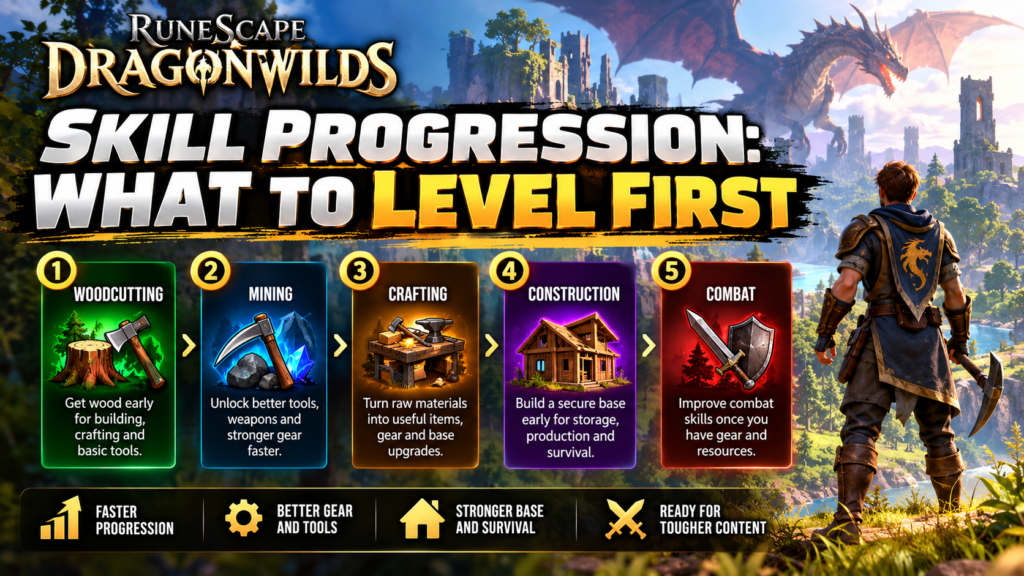
RuneScape: Dragonwilds spreads its skill system across four categories, and per games.gg’s early-priority guide, one specific skill sits above the rest for new players — not because it’s flashy, but because of what it improves indirectly. See our beginner’s guide for the broader onboarding picture.
The four skill categories
Per Hack the Minotaur’s dedicated skills breakdown, Dragonwilds organises its skills into:
- Combat: Attack, Magic, Ranged, and Prayer
- Gathering: Woodcutting, Mining, Farming, and Fishing
- Artisan: Runecrafting, Construction, Artisan, and Cooking
- Support: Agility
Notice that Agility stands alone in the Support category — a single-skill category rather than a group of four like the others, which itself hints at why guides single it out for special attention.
Why Agility is the actual top early priority
Per games.gg’s guidance, Agility, Construction, Runecrafting and Artisan form the backbone of early progression — but Agility specifically is called out as the single top priority. The reasoning given is that better stamina recovery, which Agility improves, feeds into nearly everything else you do: gathering, travel, combat repositioning, and general exploration all benefit directly. This is a genuinely different kind of priority than a combat skill that only improves your damage output in fights — Agility’s benefit compounds across essentially every other activity in the game, which is why it outranks skills that might otherwise look more immediately rewarding.
Specific level thresholds worth building toward
The sourced guide names three concrete unlock levels that reward deliberate early investment rather than incidental leveling:
- Attack level 11 unlocks Tempest Shield.
- Runecrafting level 8 unlocks Windstep, alongside broader rune recipe unlocks at that same tier.
- Mining level 11 unlocks Rocksplosion.
Knowing these specific thresholds in advance lets you plan a deliberate push toward one of them rather than levelling all your skills evenly and eventually stumbling into the unlock — if Rocksplosion sounds particularly useful for your current playstyle, for example, focusing Mining specifically until level 11 gets you there faster than balanced, spread-out leveling would.
Combat skills: don’t spread your XP evenly at the start
Dragonwilds runs three separate combat tracks — Attack, Ranged, and Magic — and per the sourced guidance, all three are eventually worth developing since different enemies call for different approaches. But early on specifically, spreading your combat XP evenly across all three slows your progress in each one without giving you a genuinely strong option in any of them yet. The recommended starting point is Attack specifically, building one combat track to a useful level before diversifying into the other two.
Gathering skills: the biome-tiered leveling loop
For efficient Mining specifically, the sourced guide lays out a clear biome-based progression loop: level 1-30 on Copper/Tin ore in Verdant Marsh, 30-60 on Iron/Coal in Cragstone, and 60-99 on Mithril and Adamantite in Subterranean Caverns. This structured approach matters because mining ore below your effective level range in a given biome is generally less efficient than moving to the next biome’s tier once you’ve outgrown the current one — treating this as a loop with defined transition points rather than mining wherever is convenient speeds up the overall grind.
Practical early-game priority order
- Invest in Agility first, even before it feels exciting — its stamina benefit compounds across gathering, travel, combat and exploration alike.
- Push Attack to at least level 11 for Tempest Shield before spreading into Ranged or Magic.
- Target Runecrafting 8 for Windstep and the broader rune recipe unlocks if you’re leaning into a magic-adjacent playstyle early.
- Follow the biome-tiered Mining loop (Verdant Marsh → Cragstone → Subterranean Caverns) rather than mining whatever ore is nearest regardless of your current level.
- Resist spreading combat XP evenly across all three tracks at the start — build one up first, then diversify once you have a genuinely useful combat foundation.
For general onboarding, see our beginner’s guide, and check our PC and Steam platform notes.