Last verified 2026-09-12 by ReviewGamers Editorial
Stick drift is not bad luck and it is not you being rough with your controller. It is a wear mechanism with a specific, well-understood cause, which is exactly why some sticks suffer from it and others structurally cannot.
Understanding the mechanism is what lets you decide whether paying more is worth it — and what to say when a controller fails sooner than it reasonably should.
Why drift happens
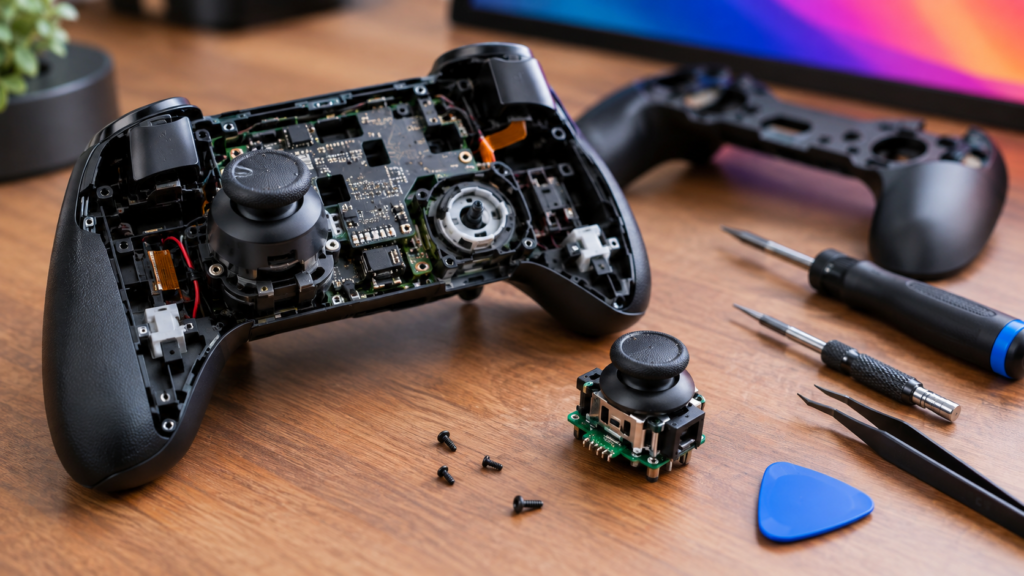
A traditional analog stick uses a potentiometer: a variable resistor with a physical wiper that slides across a resistive carbon track. Moving the stick moves the wiper, changing resistance, which the controller reads as position.
That contact point is the problem. Every movement is friction. Over time the track wears, debris accumulates, and the resistance the controller reads at centre stops matching actual centre. The controller now believes you are pushing the stick when you are not. That is drift.
It is not a defect in the sense of a manufacturing mistake. It is the expected end state of a component with a sliding contact. The only real question is how long it takes.
Secondary sources put typical potentiometer stick lifespans in the region of 400 to 2,000 hours. That is a wide band, and it is a claim we have not verified — but the shape is right, and it explains why two people with identical controllers have wildly different experiences. Someone playing 20 hours a week reaches the bottom of that range in months.
What hall effect changes
A hall effect stick senses position using magnetic fields and a semiconductor sensor. There is no wiper and no track. Nothing slides against anything.
Because the failure mode of a potentiometer is contact wear, and hall effect has no contact, that particular failure mode does not begin. This is a structural difference, not an incremental improvement.
Secondary sources cite independent testing of 10 million-plus actuation cycles before signal degradation, and describe hall effect sticks as lasting several times longer than potentiometer equivalents. Again — attributed, not measured by us.
What hall effect does not fix
This is where marketing overreaches and where buyers get disappointed.
- It is not immunity to all faults. Springs weaken, bushings wear, shells crack, cables fail, batteries degrade. Hall effect addresses the sensor, not the rest of the controller.
- It does not make a cheap controller good. Sensor type is one component. Build quality, ergonomics, latency, button feel and firmware all still matter, and a poor controller with hall effect sticks is still a poor controller.
- It is not automatically more accurate. Longevity and precision are different properties. A well-made potentiometer stick can feel excellent when new.
If someone is selling you hall effect as a guarantee against every problem, they are selling.
Where TMR fits
TMR — tunnel magneto-resistance — is also contactless, so it shares the core durability advantage. Secondary sources report it improves centring stability and sensitivity at small stick deflections, which matters most for precise aiming and fine analog control.
The practical position reported in 2026: TMR is technically better but costs more and is harder to find, while hall effect already delivers resolution and latency sufficient for the large majority of players and titles.
Our read of that, as a decision rule rather than a measurement: if you can find TMR within your budget and you play something where fine stick control genuinely matters, it is a reasonable premium. For most people, hall effect is the better value, and the gap to TMR is much smaller than the gap from potentiometer to either.
The Australian part, which is worth more than the sensor
If a controller develops drift within a period that is not reasonable for its price, this is a consumer guarantees issue, not a goodwill request.
Under the Australian Consumer Law, consumer guarantees apply automatically. Goods must be of acceptable quality, which includes being durable for a reasonable period given the price and how the product was described. These rights sit above any manufacturer warranty — a 12-month warranty expiring does not extinguish them, and the ACCC has publicly raised concerns about compliance in the electronics sector.
Practically:
- Your claim is against the retailer, not the manufacturer.
- “Reasonable” is judged on price and description, so a premium controller is held to a higher durability expectation than a budget one.
- Keep your proof of purchase, and describe the fault plainly: the stick registers input with no contact.
This is general information about consumer guarantees, not legal advice — but it is the part of this topic most likely to save you money.
So is hall effect worth paying for?
A decision rule, not a verdict:
- You play 10+ hours a week, or you have already replaced a controller for drift → yes, the premium is likely to pay for itself.
- You play occasionally → a potentiometer controller may outlast your interest in it. Buy on feel and features instead.
- You are buying for a child or a shared household → yes. High usage, low tolerance for a broken controller.
- You play fighting games or competitive shooters → look at TMR if it is available in your budget, because low-amplitude precision is exactly where it is reported to help.
What we have not done
We have not run our own drift testing. Doing it honestly means owning controllers, logging actuation over months, and measuring centre deviation against a published protocol — a Tier A exercise by our evidence model, because durability claims require ownership and elapsed time.
Until that exists, this page explains the mechanism and attributes every number to someone else. When we have our own drift log, it will appear here with the raw data attached.