
Last verified 2026-09-25 by ReviewGamers Editorial
GeForce NOW’s pitch is simple: stream PC games you already own from NVIDIA’s servers instead of running them locally. Which tier you’re on changes almost everything about how that actually feels, from how long you can play in one sitting to which GPU your session lands on.
Free: a real option, with real limits
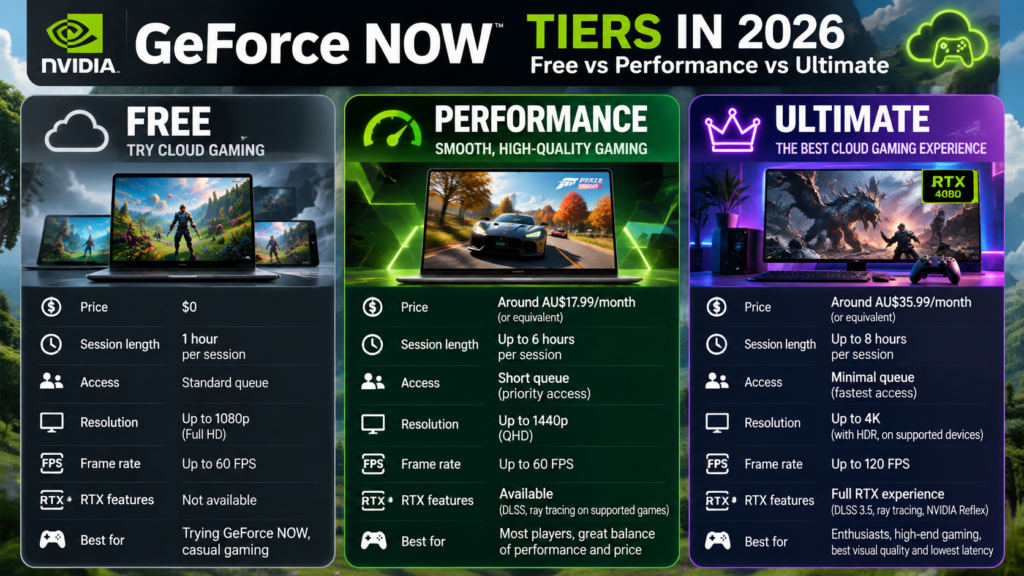
The Free tier isn’t a trial — it’s a permanent option — but it comes with an ad-supported queue in front of it and a session cap of roughly one hour before you’re kicked back to the queue to start again. That’s genuinely usable for shorter sessions or for trying the service before paying for anything, but it’s not built for long play sessions.
Performance: the value tier that actually matters for most players
Performance is priced around $9.99 a month in commonly reported 2026 figures and sits as the mid-tier option: streaming up to 1440p at 60 frames per second, better queue priority than Free, and access to RTX-capable server hardware without Ultimate’s price. For most players who just want to stop dealing with the free tier’s queue and session limit, this is the tier that solves the actual annoyance without paying for headroom they won’t use.
Ultimate: the tier built around raw hardware
Ultimate is the tier NVIDIA has been actively upgrading through 2026, migrating members onto servers built around RTX 5080-class (Blackwell architecture) hardware at the same roughly $19.99 price point the previous RTX 4080-class tier held. In practice, that unlocks streaming up to 5K resolution at 120 frames per second, or a 1080p mode pushing as high as 360 frames per second aimed specifically at competitive/esports play. Session length also extends to eight hours, well past what Free or Performance offer, alongside DLSS 4 support and a “Cinematic” quality profile NVIDIA says narrows the visual gap with a locally installed PC.
Which one actually makes sense
If you’re mainly checking whether cloud gaming works for you at all, Free is the honest starting point — the session cap is annoying but it costs nothing to find out. If the queue and session limit are the actual problem, Performance solves that for most single-player and non-competitive multiplayer use without needing the higher resolution/frame-rate ceiling Ultimate offers. Ultimate earns its price specifically for two groups: players who want the highest possible visual fidelity on a big display, and competitive players who want the 360 FPS mode’s responsiveness on a monitor that can actually show it.
What to check before subscribing
Server availability and exact session/queue behaviour can vary by region, and NVIDIA has changed tier pricing and hardware allocation more than once, so it’s worth checking NVIDIA’s own current tier page rather than assuming last year’s numbers still apply before committing to an annual plan.