
Last verified 2026-09-25 by ReviewGamers Editorial
The subscription-versus-ownership question sounds like simple monthly-cost math, but the actual decision hinges on something the cost comparison alone doesn’t capture: whether you’d still want the games you played after they potentially leave the catalogue.
The obvious math Game Pass wins
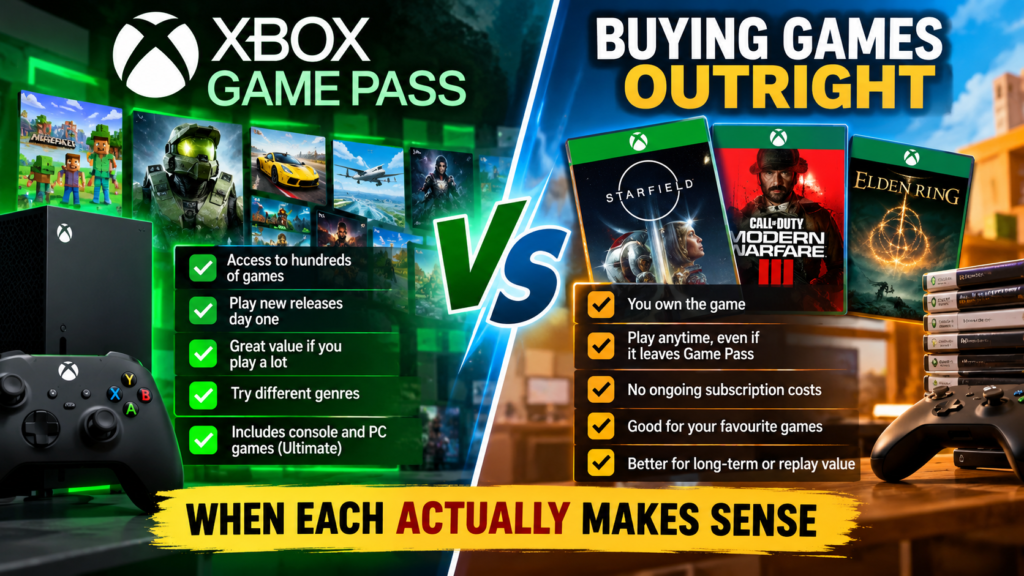
If you play a wide variety of games and don’t tend to replay the same title for years, Game Pass’s math is straightforward: one subscription cost against dozens of games you’d otherwise buy individually is an easy win, especially for trying genres or franchises you’re not sure you’ll like enough to commit to a full purchase.
The catch: games can leave the catalogue
Game Pass titles aren’t permanent — publishers negotiate limited windows, and games do rotate out. If you start a long RPG on Game Pass and it leaves the service before you finish, you either lose access or need to buy it separately to continue. This is the single biggest factor the simple cost-per-month comparison leaves out.
Day-one first-party titles change the calculation
For Xbox’s own first-party releases that launch directly into Game Pass on day one, the subscription case gets considerably stronger — you’re not weighing a rotating third-party catalogue, you’re getting the exact games you’d have bought at full price anyway, on release day, as part of the subscription you’re already paying for.
When buying outright still makes more sense
Buying outright is the better call for games you already know you’ll want to own indefinitely, replay for years, or that you specifically want available even if you later cancel a subscription — competitive multiplayer games you’ll play for a long time, or favourites you want in your permanent library regardless of any service’s catalogue changes.
A practical middle-ground approach
A workable strategy many players land on: use Game Pass to try games you’re uncertain about and to play day-one first-party releases, then buy outright only the specific titles that turn out to be favourites you want to keep permanently — rather than treating it as an all-or-nothing choice between the two models.
The honest bottom line
Game Pass wins clearly if your priority is trying a lot of games broadly, especially first-party day-one releases. Buying outright wins if your priority is a permanent library of specific games you already know you want to keep — the right answer depends on which of those two things actually describes how you play, not on the subscription price alone.